


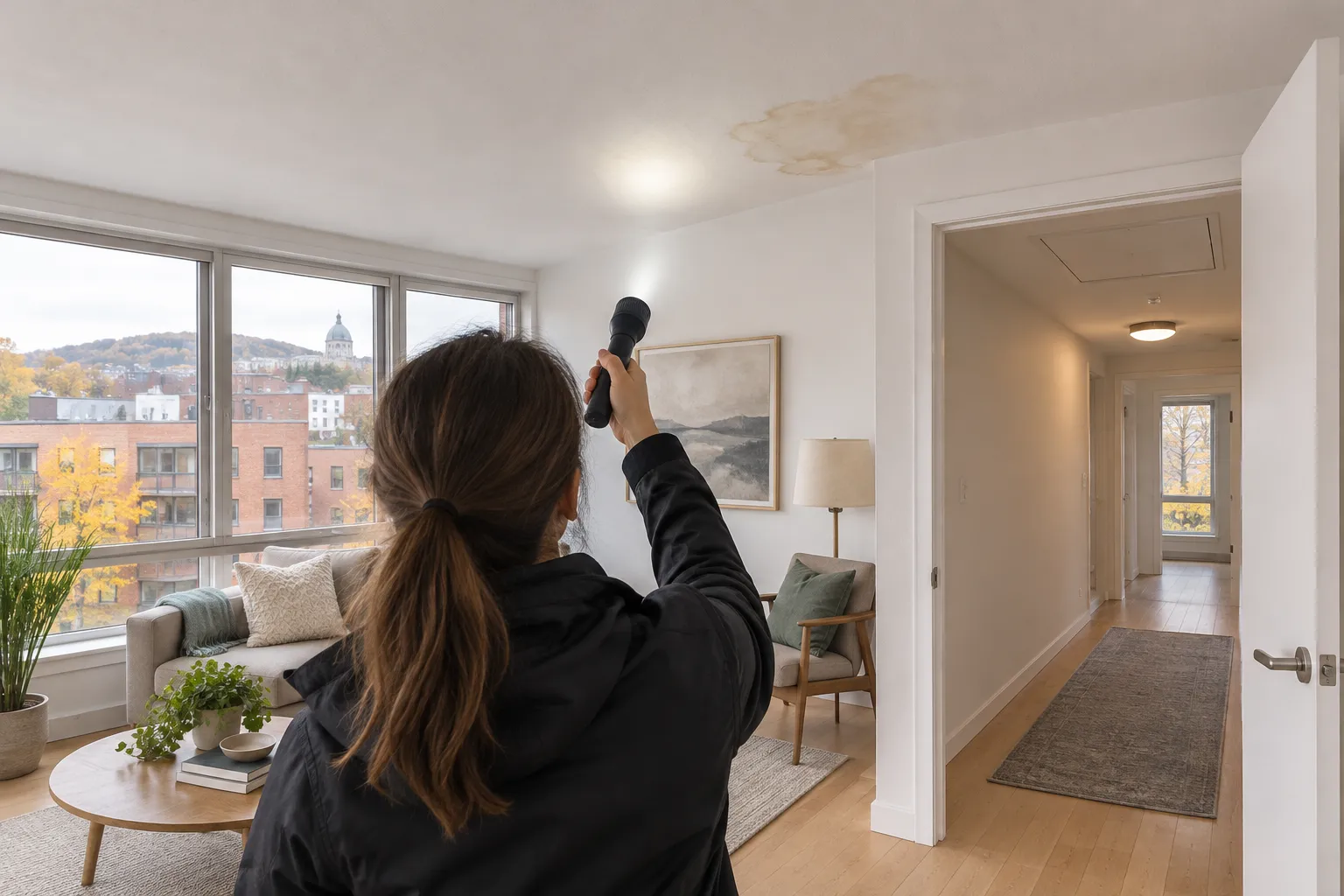
A spotless ceiling does not answer every question when you are buying a top-floor condo. Before booking the inspection, you also need to know how to access the spaces above the unit, who can authorize a visit and which documents describe work already completed.
The key is to distinguish what can be observed inside the unit, what requires an examination of common portions and what remains to be confirmed. The OACIQ strongly recommends including common portions in the inspection of a divided co-ownership property, rather than limiting it to the private portion.
To prepare for a pre-purchase top-floor condo inspection, here is how to define the scope, arrange access and obtain useful answers without confusing an observation with a diagnosis.
Three different questions: where, what and whose?
When preparing, separate these three questions:
- Where will the inspector be able to go? Inside the unit only, into the attic, onto a terrace or into certain common rooms?
- What will the inspector examine? The observable components covered by the agreed scope, depending on conditions at the time?
- Who owns each component? An individual co-owner, all co-owners or all co-owners with use reserved for certain people?
These questions are not interchangeable. Under articles 1042 to 1044 of the Civil Code of Québec, private and common portions are distinguished by their ownership and use; some common portions may also be for restricted use. Common piping, for example, may run through a private portion.
Do not assume a component's status simply because it is located inside the condo or accessible from it. Have the notary review the declaration of co-ownership and relevant documents when boundaries or responsibilities are unclear.
To establish the technical scope, first describe the building's layout to the team handling your condo inspection. A precise description of the property is more useful than simply saying “top floor.”
Inside the unit: documenting signs without assuming their source
Ceilings, walls and areas around openings
During the visit, draw the inspector's attention to stains, localized touch-ups, deformation and areas that have already been repaired. According to the Government of Quebec, stains, warping and peeling may indicate a water problem hidden behind building materials.
For each known mark or repair, ask the seller to explain:
- when it was noticed;
- under what circumstances it appeared;
- what cause was identified and by whom;
- what work was completed;
- which documents provide a record of the work.
An answer such as “it's old” deserves clarification. Look for a timeline: first appearance, investigation, corrective work, finish repairs and follow-up. The goal is not to systematically challenge explanations, but to make it possible to compare them with the observations.
Moisture: do not automatically assume a roof leak
On the top floor, it can be tempting to attribute every mark to the roof. However, according to Health Canada, indoor moisture can come from sources such as water infiltration, plumbing leaks or condensation. The location of a stain alone is therefore not enough to establish its cause.
The Government of Quebec also explains that warm air leaking outdoors carries moisture and can cause hidden condensation within the building envelope. It is therefore worth asking how observations about the ceiling, openings and ventilation relate to one another, without choosing an explanation in advance.
If there is an odour or a suspicious mark, mention it before the visit. Health Canada prioritizes finding and correcting moisture sources; its guidance document states that air testing is generally not needed to detect mould. A persistent concern should be assessed according to the circumstances, without drawing conclusions about occupants' health.
Common portions: defining what will actually be examined
The Bureau de normalisation du Québec describes an approach based on examining observable components, operating observable equipment and reviewing information about the building. According to its overview of standard BNQ 3009-500, the assessment may cover part or all of a building.
Before confirming the appointment, ask for a written answer to this question: which common portions are included in the proposed inspection scope for this building?
Ask for clarification about the spaces being considered:
- roof and roof access;
- attic, if there is one;
- terrace and accessible exterior surfaces;
- relevant corridors and stairwells;
- garage or basement;
- relevant mechanical and service rooms.
This list is intended to help prepare the discussion: it does not mean that all these spaces will automatically be included, accessible or examinable in the same way.
The roof remains an item included in the inspection
At AL Inspection, examining the roof is among the items included in the inspection, depending on the agreed scope, access and conditions. This should not be understood as a separate, exhaustive expert assessment of the roof covering and its concealed assemblies.
As a professional reference, the AIBQ describes observing the roof covering, drainage, flashings and roof penetrations, and recording the observation method in the report. Ask specifically where the roof can be observed from and which surfaces may remain out of view.
The useful question is therefore not simply “will the roof be inspected?” but rather “what observations will be possible, and what limitations will be documented?”
Arranging access before the appointment
Obtaining authorization and a responsible contact
Do not wait until the inspector arrives to find out who has the key to a hatch or a room. Ask the seller to coordinate access with the syndicate of co-ownership or property manager, and forward the confirmations to the inspector.
The APCHQ standard of practice published in October 2023 calls for written authorization from the syndicate to inspect common portions. This reference has its own scope of application: confirm which standard and agreement apply to your building rather than assuming the same document governs every situation.
Your coordination email should ask for:
- the spaces for which access is authorized;
- the name and cellphone number of the person responsible;
- the time that person will be available;
- the location of keys and access points;
- any escort requirements;
- known restrictions.
Do not confuse authorized access with safe access
Authorization does not necessarily make a visit feasible. The AIBQ specifies that entry into an attic depends, among other things, on a sufficiently large access opening and sanitary, safe conditions. It also provides for limitations when access is blocked or a visit could cause damage.
To help with preparation, send photos of the access point if they are available. However, leave it to the inspector to determine the appropriate method on site. Do not ask the seller to force open a hatch, remove materials or improvise a means of access.
Anticipating weather-related limitations
In its questions and answers document about standard BNQ 3009-500, the BNQ gives a dangerously steep roof and snow concealing components as examples of limitations to document.
Before the visit, ask how a significant limitation will be addressed: observation from another vantage point, document review, a recommendation for further checks or a discussion about a later visit. None of these options should be assumed to be included without confirmation.
Documents to request to understand what is above the condo
Declaration, available plans and history of work
Prepare a separate file for documents concerning the spaces above the unit. Where they exist, request:
- the declaration of co-ownership and relevant amendments;
- plans that help explain access points and assemblies;
- previous reports on the roof or attic;
- invoices and descriptions of work;
- warranties and their conditions;
- documents relating to reported water infiltration or insurance claims;
- meeting minutes discussing recurring problems or proposed work.
Do not settle for an invoice labelled “roof repair.” Ask which area was treated, what problem was being addressed and whether follow-up took place. Send the documents early enough to agree with the inspector on which ones can be reviewed within the inspection scope.
Maintenance log and contingency fund study
According to the Government of Quebec, the maintenance log describes, among other things, the components and work to plan for, while the contingency fund study addresses funding for major repairs and replacement of common portions.
Request the available versions and identify the passages concerning the roof, building envelope and equipment above the unit. Your goal is to compare the day's observations with the history and planned work, not to turn the pre-purchase inspection into a financial analysis.
The Société d'habitation du Québec's explanatory guide provides for a transitional period, generally until August 15, 2028, to obtain these documents, with specific provisions when the developer controls the syndicate or has recently relinquished control. Their absence must therefore be interpreted according to the applicable circumstances, rather than automatically treated as non-compliance.
Syndicate's certificate on the state of the co-ownership
According to the Government of Quebec, the syndicate must provide this certificate to the seller within 15 days of the request. It includes information on major repairs completed, significant work planned, insurance and litigation.
Ask the seller to obtain it early enough to allow for review. For a top-floor unit, pay particular attention to references to the roof, building envelope and work related to the spaces above. The certificate and the inspection serve different purposes: obtain both rather than treating one as a replacement for the other.
Three situations to distinguish findings, explanations and verification
The following examples are hypothetical. They illustrate a way to prepare questions and are not diagnoses or work performed by AL Inspection.
A stain remains visible after a reported repair
The seller says that water infiltration has been corrected, but a mark remains on the ceiling. Ask for the date of the event, the document identifying the cause, the description of the work and follow-up information.
Then ask the inspector to distinguish what they observe from what they have been told. The phrase “repair reported by the seller” should not be understood as independent confirmation that the repair was effective.
The unit appears to be in good condition, but no access to the spaces above is available
Ask what conclusions can be drawn about the unit and which remain limited by the lack of access. Then seek the recommended additional reports and information.
Avoid reframing the situation as “everything was checked.” Instead, record the spaces visited, the areas not examined and the steps still to be taken.
A terrace is reserved for the condo
Do not assume that exclusive use means every component is private or that one person is responsible for all maintenance. The Civil Code recognizes common portions for restricted use; have the status and responsibilities clarified using the co-ownership documents.
For the technical inspection, ask which surfaces will be visible and which areas will remain concealed by the terrace's fixtures and layout. Keep this question separate from legal responsibilities.
Reading the report with its limitations in mind
The OACIQ recommends reading the report carefully and asking the inspector your questions. For a top-floor condo, organize your reading around four categories:
- Observations: what was actually seen or checked.
- Information received: statements and documents reviewed.
- Limitations: inaccessible spaces and surfaces not observed.
- Recommendations: information or further checks to obtain.
You can explore this approach further with our guide to reading a pre-purchase inspection report.
Turn each important recommendation into a follow-up question: what needs to be clarified, by which qualified person and with what document? According to the BNQ, a technical expert assessment may be recommended when observations suggest a problem but the available information does not support a conclusion.
For effects on the promise to purchase, deadlines or responsibilities, have the relevant professionals review your situation. This article does not replace a technical and legal review specific to the transaction.
Frequently asked questions
Is a hatch inside the condo enough to allow an attic inspection?
Before the appointment, ask who owns the space, who authorizes access and what conditions apply. Forward this information to the inspector, who will also need to assess the actual conditions for the visit.
Should you send an old report to the new inspector?
Offer to send the complete report, its date, its scope and its appendices. Ask how the inspector will be able to use it. Avoid sending only a reassuring sentence taken out of the context of its limitations and recommendations.
Does a pre-purchase inspection replace the maintenance log?
No. The BNQ expressly distinguishes an inspection for a transaction from the processes that allow a syndicate to establish a maintenance log. Request the syndicate's documents to complement your inspection, without confusing their purposes.
What should you do if the syndicate does not confirm access?
Notify the inspector and your broker, if applicable, immediately. Ask which parts of the inspection remain feasible and what steps are proposed. Have any consequences for your purchase conditions and deadlines checked rather than assuming an automatic extension.
Conclusion: arrange access for a clearer picture
For a top-floor condo, prepare the inspection scope, access arrangements and documents together. Confirm which common portions are covered, identify the person responsible for the keys and gather the history of work above the unit.
After the visit, focus on understanding what was observed, what is based on information received and what still needs to be verified. This distinction is what makes the report genuinely useful for your decision.
To prepare for your pre-purchase inspection in Greater Montréal, send AL Inspection the building's layout, known access arrangements and your concerns. You can then request a quote and define the inspection scope suited to the property.
Sources
- OACIQ — Inspection: recommends inspecting common portions in divided co-ownership properties and reading the report carefully. View the page.
- Publications du Québec — Civil Code of Québec, Book Four: distinguishes private portions, common portions and common portions for restricted use, notably in articles 1042 to 1044. View the document.
- Government of Quebec — Recognizing and eliminating mould: describes possible signs of moisture and the importance of identifying its cause. View the page.
- Health Canada — Guidance on moisture and mould: presents moisture sources and the limitations of air testing. View the document.
- Government of Quebec — Airtightness: explains how air leaks carry moisture and how condensation can occur within the building envelope. View the page.
- BNQ — Residential building inspection: presents the approach to assessing observable components. View the page.
- AIBQ — Pre-purchase inspection: describes roof observation and conditions for attic access. View the page.
- APCHQ — Standard of practice, October 2023: provides, within its scope of application, for written authorization to inspect common portions. View the document.
- BNQ — Questions and answers, version 2.0: explains limitations, recommendations for expert assessments and the distinction from the maintenance log. View the document.
- Government of Quebec — Measures applicable to divided co-ownership properties: explains the functions of management documents and the deadline for providing the syndicate's certificate. View the page.
- Société d'habitation du Québec — Explanatory guide to the measures: presents the transitional provisions concerning the maintenance log and contingency fund study. View the guide.